Built with a foundation.
Every detail.
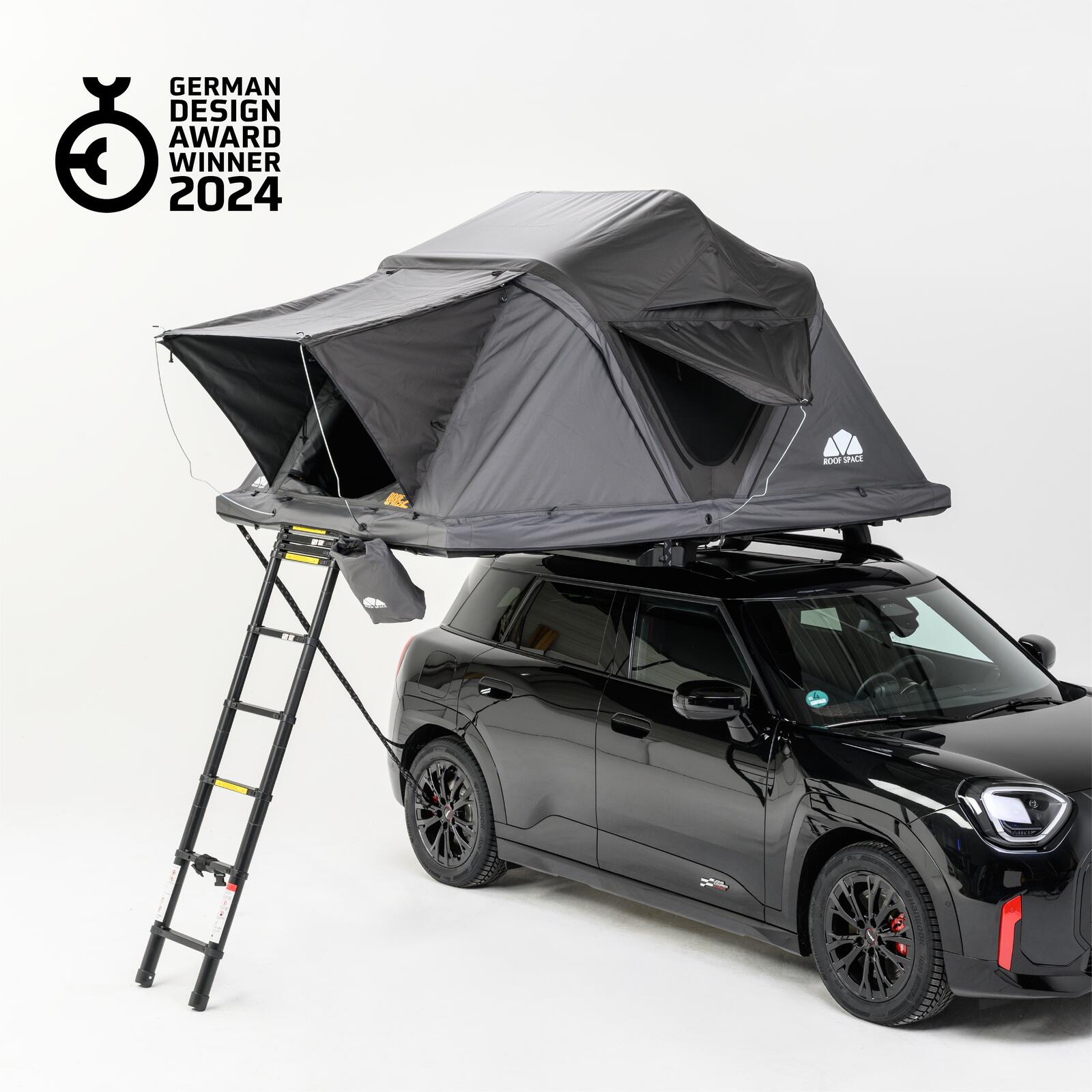
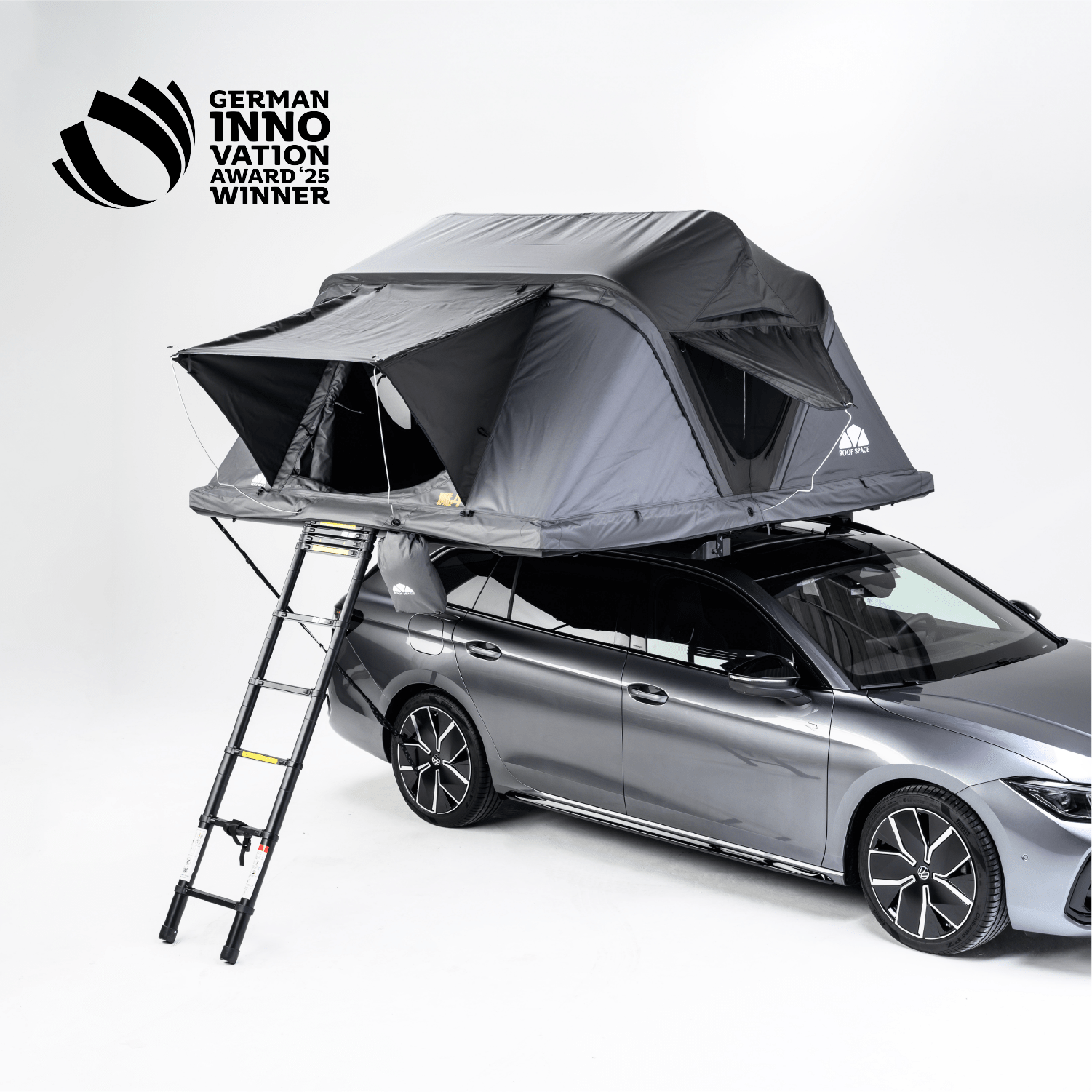
Not an off-the-shelf roof tent – but one designed from the drawing board. Every screw, every seam, and every movement has a technical reason.
No off-the-shelf
rooftop tent.
Roof Space was born from a simple idea: If something is going to be used daily, it has to work every day – without compromises, without workarounds.
Every design choice for this tent has a technical reason. This page explains what they are.
Internal gas springs. No effort required.
Rain chamber test. Documented to be watertight.
Laser-welded. Self-supporting. Patented.
Each tent individually inspected. Documented with serial number & inspection report.
57 Details - one goal:
Perfection in the roof tent
57 Details - one goal:
Perfection in the roof tent
We spent years developing a hybrid rooftop tent that meets the highest quality standards. In this video, founder Jakob takes you on a deep dive through 57 well-thought-out details & features that you wouldn't even notice at first glance.

Solo setup.
In 1 minute.
The same every time.
Reliable, reproducible and independent – not through magic, but through sophisticated mechanics.
Open the trunk lid, hook in the ladder – done.
Mattress narrow, release lock, close trunk lid.
Maximum force is required to open it. A child can do it.
Traditional roof tents have external gas springs – visible, mechanically stressed, and exposed to the elements. Roof Space relocates the springs entirely internally. The spring force is geometrically optimized: evenly distributed across the entire opening angle, without any jerky movements.
Dismantling explained in three steps:
1. Prepare: Remove the ladder and fold up the tent fabric at the corners using the elastic loops.
2. Secure: Fold the case together and securely lock it in place with the included strap.
3. Stow: Simply guide the remaining tent fabric inwards and finally close the case.
The belt locking system allows the case lid to be locked in a defined intermediate position - both hands remain free for easy stowing of the tent fabric. The belt required for this is readily available in the accessory pocket integrated into the lid. Special fasteners are attached to the belt, with which the locking is actively carried out on the case. This makes a smooth solo dismantling possible without outside help.
Opens in a controlled manner.
Closes securely.
Holds up under vibration.
Off-road capability is not a marketing ploy – it's the design goal.

Rotation & Lever Geometry
The intelligent arrangement of the gas springs enables the safe opening and closing of the case with minimal effort. The hinge geometrically guides the rotation when opening so that no load peaks, jolting, or uncontrolled movement occur over the entire opening angle.
→ Lexikon: Hinge kinematics in detail
Both hands free. Always.
The suitcase lid can be locked in a defined intermediate position – completely without resistance. The strap system ensures that you can easily fold the fabric into the suitcase.

The vehicle becomes part of the structure.
The multifunctional strap not only serves as a dismantling aid but also acts as a safety guy line between the trunk lid and the rim in stormy conditions. In strong winds, the vehicle thus shares the wind load. The forces are directed straight into the vehicle structure, effectively relieving the tent's springs and hinges.

200 kg load capacity. Self-supporting. Without supports.
The sleeping platform follows the suspension bridge principle: The combination of an aluminum frame and high-strength steel cable forms a redundant support structure that can withstand a load of 200 kg even without ladder support. No bracing, no intermediate struts.
*Always use a ladder as additional support, as we cannot guarantee the individually used substructure.
100% Alu 6061-T6.
Laser welded.
Built to last for decades.
Quality starts with the materials.


Aluminium 6061-T6. The structural standard of the aerospace industry.
High yield strength, good weldability, excellent corrosion resistance. A load capacity of 30 kg is permitted during travel. As it is an aluminum case, subsequent mounting of accessories such as L-tracks, as well as custom attachments, is individually possible.

Polyester vs. Polycotton: The honest comparison chart.
→ Lexikon: Water column ABC explained


The details that make the difference.
SBS Zippers: Textile loops instead of metal pulls – silent in the wind and easy to grip in the cold.
Reinforced Eyelets: Logo-embossed, with reinforced seam allowance.
Side Spring Steel Mount: Self-developed M10 flange screw with Torx drive and integrated spring steel mount.
21 days of continuous rain.
It remained tight-lipped. Documented.


The two-phase sealing system.
Roof Space seals in two stages. The outer layer first breaks the pressure from the wind before it reaches the actual seal.
Only then does the final layer seal – without any back pressure. No dust, no water, even after 200 km on the motorway.
Level 1 – Pressure management: The outer lip breaks the dynamic pressure during driving.
Level 2 – Final sealing: Behind the first lip, there is silence.

Every screw checked.
Every tent inspected.
Spare parts available directly from us.
Quality control begins with the design principle: replaceable instead of disposable.


Torque test – the red dot
Each screw was tightened to the specified torque using a calibrated torque wrench and marked with a red dot.
Serial number & traceability
Every single tent has its own serial number and is checked against the quality certificate checklist as well as documented with photos. This allows us to retrospectively determine the production date and thus the appropriate spare part and accessory.
Quality certificate – 15+ test points
15-point inspection with photo documentation before delivery.
Spare parts available for: gas springs, ladder, mattress, zippers, tent fabric, fasteners, hinge, sealing lip
Intended until
into detail.
If the foundation is sound, the rest can be thought through systematically.


Panoramic windows & blackout blinds
Starry sky or complete blackout. Both in seconds.
Anti-condensation mat
A healthy sleeping climate is not an extra for us. While other manufacturers only offer it as an accessory, the anti-condensation mat is integrated as standard in the Roof Space.
USB dimmable light strip
Pleasant, warm white light for a feel-good atmosphere. Steplessly dimmable. Powered via USB.
Hammock & Hooks
With the universal hook, both hammocks and hanging chairs, as well as individual suspension options, can be attached directly to the suitcase.
Roof terrace
Everyday life off - panoramic mode on. Rooftop terrace feeling with panoramic mode open on both sides. Your viewing platform to enjoy nature - no matter where you are.
Quick-assembly ladder
The ladder can be hooked in with a single movement and can also be used when the case is closed.
Lockable + anti-theft nuts
Case lockable. Anti-theft wheel nuts sold separately - screws can only be removed with a special key.
Inner pocket & storage space
Pocket on the suitcase lid. Four pockets in the interior as well as six hanging points (e.g. for a small lamp or jackets).
From the garage
for the patent application.
Materials
Aluminium and polyester are pure materials and can be processed in established recycling cycles.
Aluminium beats GRP
Glass fiber reinforced plastic (GFRP) is the industry standard – and not recyclable. Roof Space ruled out GFRP from the outset.
→ Lexikon: explained hereRepairable = longer use
In our opinion, the most sustainable tent is the one that stays in use the longest. We offer spare parts directly, so there is no need to buy a new one just because of a defective part.

Built because the right one didn't exist.
Roof Space began with frustration over everything that didn't work on existing rooftop tents. What followed were years of iterative development, real-world field tests on three continents, and finally, a patent.
Read the founder's story →For those who want to know
the details.
All the in-depth technical information is right here – no need to switch pages.
Convinced.
What's next?
Find a roof tent
You know what you want. Now find your roof space based on vehicle, size, and extras.
Find a roof tent →Roof Space Lexicon
Water column, kinematics, cantilever – all the nerd stuff, directly accessible.
Go to the glossary →Read the founder's story
How frustration with the existing system led to a patent application.
Read the story →This feature requires Vue.js to be available in the theme.